




AI Summary by Talkbar
What is a conversational AI agent?
A conversational AI agent is software that holds natural language conversations with users, understands what they’re trying to accomplish, and retrieves or acts on information to help them. Unlike traditional chatbots that follow pre-written scripts, AI agents reason about each question and adapt their responses based on context.
Why are websites the best fit for conversational AI agents?
Websites are where visitor intent is highest and patience is lowest. A conversational AI agent works across the entire site, not just a single workflow, meeting visitors wherever they are. Each interaction also produces valuable signals about what visitors are looking for and where the website may be lacking.
How do conversational AI agents work?
A conversational AI agent processes a visitor’s question using natural language understanding to interpret intent. It then searches site content using semantic matching rather than simple keywords, constructs a direct and sourced response, and maintains context across multiple turns in a conversation. It can also ask clarifying questions or route complex cases to human support.
What are common use cases of conversational AI agents?
Common use cases include ecommerce product discovery, B2B lead qualification, customer support automation, healthcare and financial services navigation, onboarding assistance, feedback collection, and proactive engagement based on visitor behavior signals.
Why does intent data matter?
Intent data captures what visitors actually want, not just what they click. When aggregated, it reveals content gaps, competitive insights, product positioning issues, and the language audiences use to describe their needs. This turns everyday conversations into continuous market research.
What should you look for when choosing a conversational AI agent?
Look for grounding in actual site content to avoid fabricated answers, clear source attribution, automatic content freshness, fast response times, brand voice customization, deep analytics, simple deployment, and the ability to scale reliably during traffic spikes.
Conversational AI agents: What they are, how they work, and why websites need one
The average website session lasts under a minute. Most of that time is spent scanning, not reading. When a visitor arrives with a specific question and the site doesn't surface an answer quickly, the session ends. The visitor doesn't bookmark the page for later. They try a competitor.
This is the problem conversational AI agents were built to address. Rather than adding more pages or restructuring navigation, they give visitors a direct way to ask what they need and receive a relevant answer drawn from the site's own content.
This guide covers what conversational AI agents are, how they work at a technical level, where they fit in a business context, and what to evaluate when choosing one. It is written for marketing leaders, product teams, and operators who have been tracking the category but haven't had the time to go deep on the details.
What is a conversational AI agent?
A conversational AI agent is software that can hold a natural language conversation with a user, understand what the user is trying to accomplish, and take actions or retrieve information to help them get there. The "agent" part is what separates it from a traditional chatbot. Where chatbots follow pre-written scripts or match keywords to canned responses, an AI agent reasons about the question, pulls from available knowledge sources, and adapts its approach based on the context of the conversation.
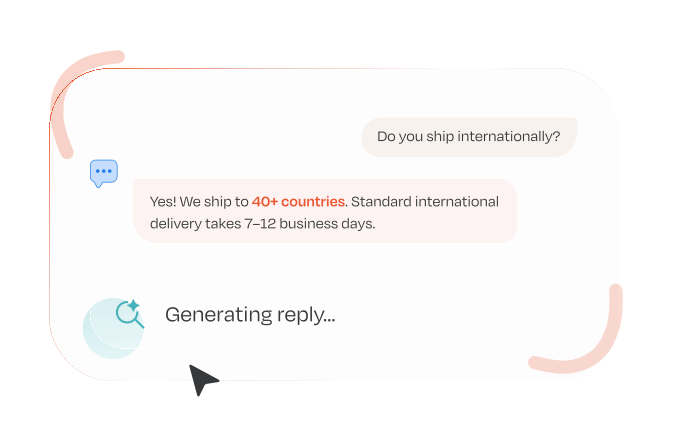
On a website, this typically means replacing or augmenting the search bar and FAQ section with a conversational interface that can process natural language queries in real time. A visitor types a question. The agent interprets the intent behind it, searches the site's content library (pages, documentation, product data, articles), evaluates which information is most relevant, and constructs a direct, sourced response. If the question is ambiguous, a well-built agent will ask for clarification rather than guessing or returning a generic answer.
The key distinction is autonomy. A chatbot executes a decision tree that someone else wrote. A conversational AI agent makes its own decisions about how to handle each interaction, within the boundaries of the data and rules it has been given. That difference matters most when visitors are asking questions the team never anticipated, which, based on most site search logs, is the majority of them.
Why websites are where conversational AI agents have the most impact?
Conversational AI agents are being deployed across many environments: internal helpdesks, developer tools, CRM platforms, customer support systems. But websites are where the impact on business outcomes tends to be most direct, for a few specific reasons.
Websites are where intent is highest and patience is lowest. A visitor on a website is often mid-decision. They arrived from a search result, an ad, or a referral with something specific in mind. A conversational AI agent meets that intent in real time, turning a moment of curiosity or comparison into a moment of clarity. In internal tools, slow answers are an inconvenience. On a website, they're a lost opportunity.
The agent can work across the entire site, not just one workflow. Most AI tools are scoped to a single function: writing, coding, data analysis. A website agent spans the full breadth of a company's public content, from marketing pages and product specs to help docs and case studies. This means it can serve a first-time visitor exploring the homepage and a returning prospect deep in the documentation with equal relevance, adapting to where each person is in their journey.
Every interaction produces a usable signal. In most AI deployments, the value is in the output: a drafted email, a resolved ticket, a generated report. On a website, the interaction itself is valuable data. Each visitor question is an unfiltered expression of what the market wants to know, what the site fails to communicate, and where the gaps between positioning and audience understanding actually sit. No other deployment context generates this kind of continuous, organic market intelligence.
The agent becomes the connective layer the site was missing. Most websites are collections of pages built at different times, by different teams, for different purposes. Navigation menus and search bars attempt to tie them together, with limited success. A conversational AI agent acts as a layer that sits across all of that content and makes it accessible through a single, natural interface. The visitor doesn't need to know which page has the answer. They just need to ask the question.
How conversational AI agents work under the hood?
Understanding the technical layer behind conversational AI agents helps in evaluating them. Here is what happens when a visitor types a question into a well-built system.
- Natural language processing: Understanding the input
- Information retrieval: Finding the right content
- Natural language generation: Constructing the response
- Multi-turn conversation and routing
- Performance and scalability
The foundation of any conversational AI agent is natural language processing (NLP). Within NLP, the most critical component is natural language understanding (NLU), which allows the system to move beyond keyword matching and comprehend what the visitor actually means. When someone types "Do you work with Shopify?", the system recognizes that as a question about integrations, not employment.
NLU uses machine learning to discern context, differentiate between meanings, and classify intent into categories: informational, transactional, navigational, or comparative. It also decomposes compound requests into sub-tasks, breaking a complex question into its component parts and addressing each one.
Once the system understands the intent, it searches across the site's content using semantic search rather than keyword matching. This means identifying content that is conceptually relevant to the question. A visitor asking "Can I use this for a team of 20?" should surface information about team plans and pricing tiers even if that exact phrase appears nowhere on the site.
The retrieval layer also weighs recency and stays grounded in actual site content. If the answer isn't in the available data, the system should say so rather than generate a plausible-sounding response from general knowledge. Source attribution, showing the visitor which page or document the answer came from, is what separates a trustworthy agent from one that erodes credibility.
Natural language generation (NLG) uses deep learning to synthesize retrieved information into a direct, coherent answer. The system is not pasting in a block of text from a web page. If a visitor asks how two pricing plans differ, the agent pulls details from both plan pages and presents a structured comparison rather than linking to two URLs.
Well-built systems include a self-evaluation step: before delivering the response, the agent checks whether it fully addresses the question. If not, the system can reformulate its search, try alternative sources, or ask the visitor a clarifying follow-up. This reasoning loop is what makes the system an agent rather than a retrieval tool. NLG quality also improves over time as the system processes more interactions and refines how it handles the kinds of questions a specific site's visitors tend to ask.
Real conversations don't happen in isolated question-and-answer pairs. A good conversational AI agent maintains context across multiple turns, tracking conversation history, resolving references ("Does that plan include it?"), and building a progressively clearer picture of what the visitor needs. After answering a question, it can suggest logical follow-ups that keep the visitor moving forward rather than dropping off.
The agent also routes each query to the appropriate knowledge domain. A product question draws from product pages; a support question pulls from help articles. If the agent isn't confident it can answer well, it acknowledges the limitation and offers to connect the visitor with a human. NLU ensures that escalation is based on a precise understanding of the visitor's need, not a generic fallback.
A conversational AI agent that takes six seconds to respond is one that visitors abandon. Well-engineered agents keep response times low through intelligent caching, load balancing, and optimized retrieval pipelines. The architecture needs to handle traffic spikes gracefully, and the system needs redundancy and graceful degradation so that backend failures don't translate into broken visitor experiences.
Real-world use cases
The range of what conversational AI agents handle on websites has widened considerably over the past two years. Here are some of the most common applications.
E-commerce and product discovery. Product catalogs with hundreds or thousands of SKUs are difficult to navigate through filters alone. A conversational agent lets a visitor describe what they need in natural language ("waterproof running shoes under $150 for wide feet") and receive a curated shortlist, along with personalized recommendations and real-time inventory availability.
B2B sales and lead qualification. Prospects evaluating software have highly specific questions about integrations, compliance, pricing at scale, and feature comparisons. These rarely map to a single page. An agent synthesizes information from across the site, qualifies the lead based on the conversation, and can book a meeting with sales when the visitor is ready.
Customer service and support. Agents handle routine inquiries across channels, resolve common issues without human involvement, and route complex cases to the right team with full conversation context. This frees support staff for problems that require judgment and empathy.
Healthcare and financial services. Both deal with complex, regulated information that visitors struggle to parse. Agents help visitors navigate care options, understand financial products, check account details, or complete routine transactions, all while staying within the boundaries of approved content and compliance standards.
Onboarding and feedback collection. Traditional forms have high abandonment rates. A conversational agent collects the same information through a more adaptive interaction, adjusting follow-up questions based on what the visitor has already shared. The same approach applies to post-purchase feedback and satisfaction surveys.
Proactive visitor engagement. Rather than waiting for a visitor to initiate, some agents recognize behavioral signals (lingering on a pricing page, returning to the same comparison multiple times) and offer relevant help at the right moment. This is the newest application and the hardest to calibrate well, but early implementations are showing measurable lifts in engagement.
The business case: From engagement to conversion
Here's where the conversation shifts from "interesting technology" to "does this actually affect the bottom line." The answer depends on how one thinks about conversion.
Most website optimization focuses on the page level: better headlines, clearer CTAs, faster load times, more persuasive copy. All of that matters. But it assumes visitors are following the paths the company designed for them. In practice, they aren't. They land on random pages from search, they skip carefully constructed funnels, and they have questions that the page content doesn't address.
A conversational AI agent operates at a different layer. It works across an entire site, on every page, for every visitor persona, at every stage of the buying process. It meets visitors where they are rather than requiring them to find the right page. This makes it less of a widget and more of a piece of conversion infrastructure.
There's a useful way to think about this: a website is a collection of pages, but visitors don't think in pages. They think in questions. "Is this the right product for me?" "What's the difference between these two plans?" "Does this integrate with the tools I already use?" "What happens if I need to cancel?" These are the moments where conversion either happens or doesn't. And they rarely align neatly with the pages a company has built.
The business impact shows up in a few specific ways.
Faster decision-making. When visitors get clear answers to their questions immediately, the time from consideration to decision compresses. They don't need to open four tabs, email a sales team, and wait 24 hours. They get what they need and act on it.
Higher engagement from existing traffic. Companies have already paid (through advertising, SEO, content marketing) to get visitors to the site. A conversational agent helps more of those visitors find what they're looking for, which means better conversion rates from the same traffic volume. That's a direct ROI improvement on existing acquisition spend.
Reduced support burden. Every question an agent answers well is a question the support or sales team doesn't have to handle manually. For high-traffic sites, this adds up quickly.
Visitor-led experiences. There's a philosophical shift here that matters. Traditional websites push visitors through a structure the company designed. A conversational agent lets the visitor lead. They ask what they want to know, in their own words, and the agent adapts. This visitor-first approach tends to produce better outcomes because it respects how people actually make decisions.
How to choose the best conversational AI agent for your website?
Not all agents are built the same. With so many options entering the market, figuring out which is the best conversational AI agent for a site comes down to a few non-negotiable criteria. Here is what separates a tool that actually works from one that looks good in a demo but disappoints in production.
Grounding and accuracy. The agent should generate responses based on the site's actual content, not general knowledge. The critical test is how the system handles questions it can't answer. The right behavior is "it says it doesn't know, but would be happy to provide assistance" If it fabricates responses, that's a dealbreaker.
Source attribution. Visitors should be able to see where the agent's answer came from. Transparency builds trust and lets visitors dig deeper if they want to.
Content freshness. Websites change constantly and the agent's knowledge base should stay in sync with the latest content. Any good agent will stay up-to-date every time a blog post is published or a product page is updated.
Response speed. Latency matters more than most teams expect. If the agent takes 10+ seconds to respond, visitors leave. Systems optimized for low-latency responses that can handle concurrent users without slowing down should be prioritized.
Brand voice and customization. The agent speaks on behalf of the company. It should sound like the company, not like any generic AI tool. The ability to customize tone and response style as well the appearance of the agent itself is important.
Analytics depth. As discussed earlier, the analytics layer is critical. Conversation transcripts, intent analysis, topic clustering, and performance metrics have now become standardised features.
Integration and deployment. How does the agent fit into the existing tech stack? Can it work across the marketing site, documentation, and product pages? What is the implementation effort? A tool that requires months of setup and constant maintenance is a harder sell than one that works out of the box and improves over time.
Scalability. If the site gets a traffic spike, the agent shouldn't fall over. Architecture details matter like, load balancing, caching strategies, and how the system handles peak loads.
Wrapping up
Conversational AI agents aren't a novelty or a nice-to-have feature bolted onto a website for appearances. They address a real, measurable problem: the gap between what visitors are looking for and what a website can currently make easy to find.
The technology has matured to the point where these agents can hold genuinely useful conversations grounded in actual site content, adapt to what each visitor needs, and generate insights that improve the site over time. The question isn't whether conversational AI agents will become standard for high-performing websites. It's whether a given company will adopt one before or after their competitors do.
For those evaluating options, Talkbar is an AI agent built specifically for websites, designed to help visitors get answers, make confident decisions, and convert at the moment their intent is highest. It's worth a look.