




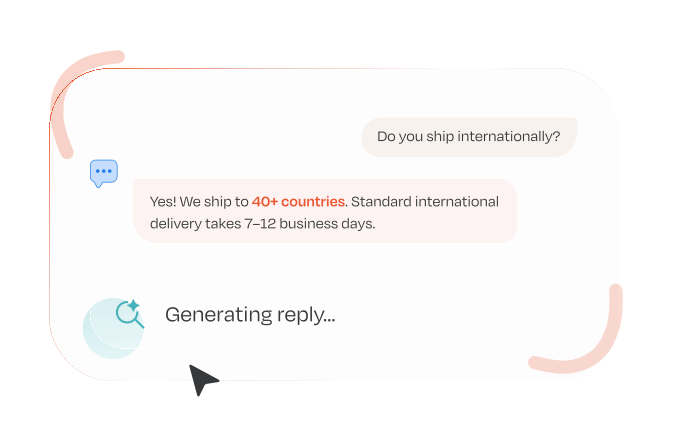

AI Summary by Talkbar
What does an AI shopping assistant do for ecommerce stores?
An AI shopping assistant engages visitors in real-time conversation, interprets their questions against a store's product catalog and content, and returns direct answers that support purchase decisions. It responds to stated shopper intent rather than relying only on behavioral signals.
How is an AI shopping assistant different from a standard ecommerce chatbot?
Traditional ecommerce chatbots follow predefined scripts and handle a limited set of support requests. AI shopping assistants understand open-ended natural language, navigate an entire product catalog, and adapt responses based on what a shopper is actually trying to accomplish during the buying journey.
What data does an AI shopping assistant need to work accurately?
Accurate performance depends on structured product data such as pricing, inventory, and variant attributes, along with supporting content like FAQs, shipping details, and store policies. The quality and completeness of this information directly affects the relevance and reliability of responses.
Which AI shopping assistant features matter most for ecommerce performance?
The most important capabilities include deep catalog integration, access to real-time inventory and variant data, natural language understanding aligned with shopper vocabulary, sitewide availability across key pages, and analytics that reveal what visitors ask rather than only what they click.
What should ecommerce marketers expect from AI assistant analytics?
AI shopping assistant analytics capture visitor intent by recording the questions shoppers ask. This helps marketers uncover content gaps, identify recurring purchase objections, understand customer language, and prioritize improvements that reduce friction in the buying process.
How does an AI shopping assistant affect conversion rates?
By answering product questions when shoppers are actively evaluating a purchase, AI assistants reduce uncertainty and prevent visitors from leaving to find information elsewhere. Their impact on conversion depends on how much existing purchase friction is caused by unanswered questions versus other factors such as pricing or shipping.
Ecommerce stores lose conversions not from lack of traffic, but from unanswered questions. A visitor arrives, runs into something the product page does not address, and leaves. An ecommerce AI shopping assistant gives that visitor a way to ask and get a direct answer from the store's own catalog and content. For merchants evaluating the best AI shopping assistant for ecommerce, the question is not whether the category delivers value, but which capabilities determine whether a specific implementation does.
This blog covers how ecommerce AI shopping assistants work technically, what the product data requirements look like, how Shopify stores implement them, and what marketers measure from the output. It builds on the pillar blog on AI shopping assistants and focuses specifically on the ecommerce implementation and marketing layer.
Why ecommerce specifically needs this
On an ecommerce store, a visitor exit after a paid acquisition is a lost sale. Ecommerce sites carry friction that content sites do not: large catalogs, variant combinations, sizing, compatibility questions, return policies. Most product pages are built for the average visitor. They are not built for the specific question the person in front of them has right now.
An AI shopping assistant responds to that specific question rather than routing the visitor through navigation built for someone else's journey.
How an AI shopping assistant processes a visitor question
- Natural Language Understanding
- Retrieval from Product Data
- Response Generation
- Session Context
Natural language processing interprets what the visitor is asking: which product, which attribute, and what constraint applies. A question like "does this come in size 8 in black" is not a search query; it requires checking the intersection of two variant attributes simultaneously. A system that interprets it loosely returns results for size 8 or black separately, which does not answer the question.
This is where AI shopping assistants differ from site search. Search matches keywords. An AI assistant interprets meaning, so a visitor asking for "something warm for camping in late October" gets results based on inferred intent rather than exact terms. Amazon's Rufus AI shopping assistant operates on this same principle at scale, allowing shoppers to ask open-ended product questions and receive contextual answers rather than a keyword-matched results page. The shift from search to conversational product discovery is no longer experimental; it is the direction the category has committed to.
Once the question is interpreted, the assistant retrieves relevant data from the catalog: variant tables, attribute fields, inventory status, pricing, and supplementary content. Retrieval accuracy depends on how well the product data is structured. Sparse descriptions and inconsistent field naming produce vague responses. This is why implementations frequently surface catalog data quality problems that were invisible in traditional search.
The retrieved data is synthesized into a natural-language answer grounded in the store's actual content. This grounding is what keeps responses accurate rather than generated from general model knowledge.
The assistant tracks conversation state across turns so follow-up questions are handled coherently. If a visitor asks about a jacket and then asks "does it come in petite sizing," the assistant resolves "it" from the prior turn rather than treating the question as a new query. Without this, visitors repeat themselves and the interaction breaks down.
What the product data layer requires
The most common reason implementations underperform is not the assistant's capability. It is the state of the product data it reads from.
- Structured Variant Data
- Inventory Accuracy
- Product Descriptions and Policy Content
Variant attributes need to be consistently labeled across the catalog. If sizes are labeled "S / M / L" on some products and "Small / Medium / Large" on others, the assistant has to resolve that inconsistency before returning an answer. Normalization across the catalog eliminates this problem.
The assistant's stock responses are only as accurate as the inventory data it reads. Assistants reading from a static export or a daily sync introduce a lag window during which inventory answers may be wrong. Real-time or near-real-time sync is the standard to work toward.
For questions about materials, care, compatibility, or intended use, the assistant reads from product descriptions. Thin descriptions produce thin answers. Product descriptions written to address common visitor questions return more useful responses.
Policy-related questions, return windows, shipping timelines, size guides, fall outside product data entirely. An assistant configured with only catalog access will fail on these. Giving it access to policy and informational content broadens the range of questions it handles accurately.
What sets ecommerce use cases apart
- Product Complexity and Purchase Confidence
- Intent Signals from Visitor Questions
When a visitor is choosing between products that differ by material, weight, or warranty, the product page often cannot answer every relevant question on its own. An AI shopping assistant for ecommerce fills that gap in real time: one question, one direct answer, from the store's actual catalog data. This is particularly valuable for stores with technically complex or high-consideration products, where the AI enhanced ecommerce shopping assistant effectively functions as a knowledgeable sales layer that scales across every visitor simultaneously.
The moment before add-to-cart is where most conversions are lost. Uncertainty about fit, compatibility, or return terms pulls visitors out of the purchase flow. An assistant that resolves that uncertainty at that moment is directly contributing to conversion.
Every question a visitor asks reveals something: what information is missing, what is creating hesitation, what the product page is not communicating. A visitor clicking around a product page shows where attention goes. A visitor asking "does this work for sensitive skin?" states exactly what they need to know before buying. That distinction is directly usable for product page optimization and content decisions.
How shopify stores implement an AI assistant
- Catalog Connection
- Placement Across Store Sections
- Analytics and Feedback Loop
Most implementations use Shopify's API to read product data including titles, descriptions, tags, metafields, variants, and inventory levels. Metafields matter for stores that keep structured attribute data, such as material composition or technical specifications, outside the main description field. Stores using third-party PIM systems may need additional configuration to make all relevant data accessible.
An assistant only on product pages misses visitors with questions earlier in the journey, on collection pages or search results pages, where a question may determine whether they click through at all. Placement should reflect where in the session visitors are most likely to have questions. Stores with complex categories benefit from earlier placement; stores where questions arise mainly at the product level may find product page placement sufficient.
Reviewing conversation data on a regular cadence, question frequency by product or category, and unanswered questions creates the feedback loop that improves the assistant and the store's content over time. The initial review period typically surfaces the most immediate data quality and content gaps. Subsequent reviews shift toward identifying emerging question patterns.
Where ecommerce AI chatbots fit in
The terms "AI chatbot for ecommerce," "ecommerce AI chatbot," and "AI shopping assistant" are often used interchangeably, and the line between them has narrowed significantly. A traditional chatbot for ecommerce follows scripts, handles a defined set of queries, and routes complexity to a human. It works for post-purchase support: order status, returns, basic FAQs.
Modern AI enhanced ecommerce tools, including what many merchants still call the best ecommerce chatbots, have moved well beyond scripted responses. They use language models that understand open-ended questions, generate contextual answers, and navigate product catalogs rather than just FAQ documents. The practical overlap with AI shopping assistants is now substantial.
What remains different is primary orientation. An AI shopping assistant chatbot or ecommerce interface is built for pre-purchase decisions: helping visitors find, evaluate, and choose products. A support-oriented chatbot is built for post-purchase resolution. Some platforms handle both within the same AI shopping assistant chat interface. Being clear on which problem to prioritize shapes the right evaluation.
What ecommerce marketers measure from an AI assistant
- Conversion and Engagement Metrics
- Intent Data Analysis
- Unanswered Questions
The most useful conversion metric is purchase completion rate among visitors who engaged the assistant versus those who did not, controlled for session intent. Engagement metrics include the share of sessions where the assistant was used, average conversation length, and question distribution across product categories.
Conversation logs are a structured source of intent data. Each question is a direct record of what a visitor needed to know at that moment. Aggregated across sessions, the patterns reveal which products generate the most uncertainty, which information is missing from current pages, and which visitor vocabulary differs from the store's own language. A product page generating high question volume about a specific attribute is communicating that attribute inadequately. Fixing it on the page improves conversion for visitors who never engage the assistant at all.
Questions the assistant answered with low confidence, or could not answer accurately, identify the highest-impact data and content gaps. Addressing these systematically through product data improvements or additional content improves assistant performance over time.
Key capabilities to evaluate
Catalog integration depth. The assistant should connect to live product data including stock levels, variants, and metafield attributes.
Intent recognition. The system should understand what a visitor means, not just what they typed, including ambiguous or informal phrasing.
Context retention. The assistant should carry conversation context across turns so visitors do not repeat themselves.
Source accuracy. Responses should be grounded in the store's actual catalog and content, not generated from general model knowledge.
Analytics output. Conversation data should be surfaced in a way that is actionable: question trends, unanswered queries, high-frequency topics.
Response speed. Slow responses interrupt the purchase flow. Latency is abandonment in ecommerce.
How Talkbar works as an AI shopping assistant for ecommerce
Talkbar is an AI website agent built for ecommerce and Shopify merchants. It sits on the storefront and responds to visitor questions at decision points, drawing from the store's product and content data to deliver direct, accurate answers in real time. The ecommerce AI shopping assistant interface is designed around the moment a visitor is deciding, not browsing: when a specific question determines whether they convert.
The analytics layer surfaces what visitors asked, organized by product and category, so merchants and marketers have a continuous feedback loop between what visitors need to know and what the store currently communicates. Every conversation becomes usable data for product page improvements, catalog decisions, and content gaps.