





AI Summary by Talkbar
What is an AI shopping assistant?
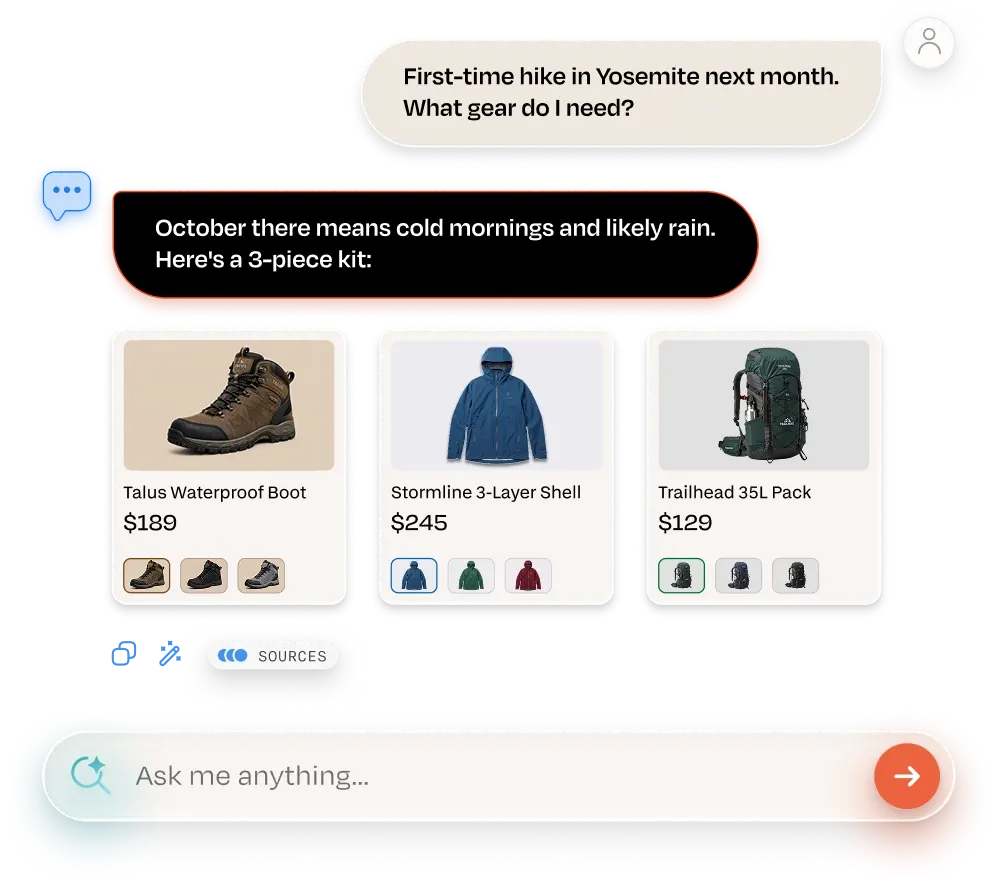
An AI shopping assistant is a conversational system on an ecommerce site that helps visitors find products, get answers, and complete purchases through natural language. It uses large language models, retrieval from the store's product catalog, and access to live content to interpret intent and produce accurate responses in real time.
What can an AI shopping assistant do?
Core capabilities include understanding visitor intent, including vague or multi-part questions, retrieving grounded information from your catalog and content, executing actions like adding items to cart or applying discount codes, and learning from each conversation to improve over time and surface insight for merchandising and content teams.
How does an AI shopping assistant work under the hood?
It relies on five layers in sequence: natural language processing to interpret the visitor's question, retrieval-augmented generation (RAG) to pull live data from your catalog, a reasoning engine to break down complex requests into sub-tasks, an action layer to execute transactions through API integrations, and a feedback loop that logs every conversation for continuous improvement.
What are the best AI shopping assistants in 2026?
The leading tools include Alexa for Shopping (formerly Amazon Rufus, rebranded May 2026), Shop.app, Rep AI, Manifest AI, Alhena AI, Gorgias AI, Zoovu, and Talkbar. Each has different strengths around catalog complexity, traffic volume, support automation, and integration depth.
How much does an AI shopping assistant cost?
Pricing ranges from free tiers (Shop.app, Manifest AI, Alhena AI, Rep AI) to over $1,000 per month for mid-market and enterprise plans. The four common pricing models are visitor-based (Rep AI), conversation-based (Alhena, Manifest), per-resolution (Gorgias), and flat-rate tiers. Custom-built assistants run from $8,000 to over $200,000 in initial development costs.
How does Talkbar fit as an AI shopping assistant?
Talkbar is an AI website agent that indexes your full site, grounds every response in live content and product data, adapts to each visitor's question across product discovery, comparison, checkout, and post-purchase moments, and surfaces intent-level data to merchandising and content teams. It deploys in under a day on Shopify and most other ecommerce platforms with no engineering required.
What Is an AI Shopping Assistant? A Complete Guide to Capabilities, Features, and Implementation
An AI shopping assistant is a conversational system on an ecommerce site that helps visitors find products, get answers, and complete purchases through natural language. The category has expanded quickly over the last two years. Amazon launched its assistant Rufus (rebranded to Alexa for Shopping in May 2026), Shopify built Shop.app, and dozens of standalone tools now compete on different capabilities, integrations, and pricing models. Market.us projects the category will reach $84.6 billion by 2034.
For ecommerce teams, the question is no longer whether to deploy one, but which one, where to start, what to expect from it, and what it will cost. This guide covers what an AI shopping assistant does, the features that separate capable tools from basic ones, how the underlying technology actually works, the leading options available in 2026, pricing models across the category, and how to evaluate and deploy one on your store.
What is an AI shopping assistant?
An AI shopping assistant is software that uses large language models, retrieval-augmented generation, and access to your ecommerce data to hold a conversation with a visitor. It interprets natural language, pulls relevant information from your catalog and content, and produces answers, recommendations, or actions in real time.
The category goes by several names. Some teams call it an AI powered shopping assistant. Others call it a conversational shopping agent, an agentic commerce layer, or an AI website agent. The underlying function is the same: a system that helps a visitor decide what to buy on your site.
The clearest description of what an AI shopping assistant is doing at any moment: it reads the visitor's question, retrieves matching information from your store, decides what to return, and either answers, asks a clarifying question, or takes an action like adding an item to the cart.
AI shopping assistant vs chatbot: how they differ
The distinction between a chatbot and an AI shopping assistant matters because the two solve different problems.
A traditional chatbot runs on predefined intents and decision trees. It handles common FAQ deflection well: store hours, shipping windows, return policies, order status. Its limits appear when a visitor asks a multi-part or open-ended question the script does not anticipate.
An AI shopping assistant uses language models, retrieval from your live catalog, and reasoning over the visitor's request. It handles open-ended queries, maintains context across a conversation, and combines information from multiple sources (product pages, reviews, policies) into a single response. Where a scripted chatbot returns a fixed message, an AI shopping assistant generates a contextually relevant answer based on your current content.
The other practical difference is action. Most chatbots respond. An AI shopping assistant can also act: apply a discount code, add a SKU to the cart, trigger a return, escalate to a human, or push the visitor to checkout.
What can an AI shopping assistant do?
The capabilities of a modern AI shopping assistant fall into four areas: understanding, retrieving, acting, and learning.
- Understand the visitor's intent
- Retrieve from across your site
- Take action
- Learn and improve
The assistant parses natural language requests, including vague, multi-part, and contextual ones. A visitor can ask for "a gift for my dad who likes camping but already has the basics, under a hundred dollars" and the assistant breaks that into constraints (recipient, interest, exclusion, price ceiling) and searches accordingly.
When the request is too broad, the assistant asks for clarification. A visitor saying "I need a good laptop" might get follow-up questions about use case, budget, and portability before the assistant commits to a recommendation.
A capable assistant indexes your full content ecosystem: product pages, FAQs, sizing guides, shipping policies, reviews, blog content, and documentation. It pulls relevant information in real time and grounds its answers in your actual content, which is what keeps responses accurate and traceable.
Action capability is what separates a useful assistant from a curious one. Modern assistants apply discount codes, add items to cart, check order status, initiate returns, suggest complementary products, and trigger checkout from within the conversation.
Every conversation generates data: what visitors asked, where they stalled, which suggestions converted, which products kept getting requested but never appeared in results. This data feeds the assistant's improvement and your merchandising and content strategy.
For the question "what can an AI shopping assistant do for users," the practical answer is this: it removes the work of finding, comparing, and deciding, and gives the visitor a direct path to a product that fits.
AI shopping assistant features that matter in 2026
The features below separate a capable AI shopping assistant from a generic LLM wrapper.
Grounded retrieval. The assistant pulls from your live catalog, not a static snapshot. Price changes, new SKUs, and policy updates show up in responses within minutes.
Source attribution. Visitors can see where an answer came from. Product page, policy document, review, blog post. Transparent sourcing builds trust and reduces returns caused by misunderstandings.
Multi-turn context. The assistant remembers what was said earlier in the conversation. If a visitor mentioned a size eight in the second message, the assistant should still have that context in the seventh.
Intent classification and routing. Every request gets categorized as informational, transactional, navigational, or comparative, and routed to the right knowledge area and response strategy.
Self-evaluation and clarification. Good assistants check whether their response actually addressed the question. If not, they refine the answer or ask for clarification rather than pretending to know.
Conversation continuity. The assistant suggests follow-up questions or next-best actions after a recommendation. Compare two products, show similar items at a different price, check inventory in a specific size.
Real-time analytics. You can see what visitors are asking, which conversations converted, and where the assistant failed, as it happens. This is what turns the assistant from a sales tool into a research function for your merchandising and content teams.
These are the latest AI shopping assistant features ecommerce teams should treat as baseline, not premium.
What is an advanced AI shopping assistant capable of?
The frontier of the category is agentic behavior, where the assistant executes tasks rather than only producing answers. This is what separates basic conversational interfaces from systems that move revenue.
Agentic capability includes:
Multi-step task completion. A visitor asks for a complete outfit for a beach wedding. The assistant pulls a top, bottoms, shoes, and an accessory that coordinate, checks each one for available size, and assembles them into a cart.
Predictive intervention. The assistant identifies when a visitor has been on a product page without scrolling, has added items and stalled, or shows other exit signals. It opens a conversation proactively with a relevant question or offer.
Cross-system orchestration. The assistant pulls data from your CDP, OMS, inventory system, and reviews platform, then combines them in a single response. “Do you have this in my size, and how does the sleeve length compare to the previous version” requires three different lookups, handled in one exchange.
Behavioral memory. For returning visitors, the assistant remembers preferences, past purchases, and prior conversations, and uses that context to personalize the next interaction.
Agentic AI shopping assistants are not a replacement for human associates on every interaction. They handle the volume of routine and semi-complex requests so the harder ones get human attention.
How AI shopping assistants work under the hood
An AI shopping assistant relies on five layers working together: NLP, retrieval-augmented generation, a reasoning engine, an action layer, and a feedback loop. Understanding what each layer is actually doing helps explain why some assistants feel like a smarter search box while others can genuinely close a sale.
- Natural language processing
- Retrieval-augmented generation (RAG)
- Reasoning engine
- Action layer
- Feedback loop
NLP turns a visitor's message into structured intent the rest of the system can act on. When someone types "something for a beach wedding, not too formal, under $150," the NLP layer is doing several things at once.
Intent classification identifies whether this is a product search, a support query, or a comparison request. Entity extraction pulls structured data out of the free text: occasion (beach wedding), formality (not formal), price ceiling ($150). Ambiguity resolution maps subjective phrases like "not too formal" to ranges across product attributes. Context retention holds onto earlier turns in the conversation, so a "size 8" mentioned three messages ago still applies to the current query.
Modern NLP is built on transformer architecture, the same foundation as GPT-class models. It handles idioms, incomplete sentences, typos, and contextual references reliably. The practical difference from keyword search is significant: keyword search requires the visitor to know the right words, while NLP-powered search understands what they mean even when the wording is loose or unfamiliar.
RAG is the architecture that keeps the assistant accurate. A standard large language model answers from its training data, which is a static snapshot that can be months or years out of date. For an ecommerce assistant, that is disqualifying. Prices change hourly, stock moves, and policies update. A model answering from memory will hallucinate product details, cite wrong prices, and reference items that no longer exist.
RAG fixes this in four steps. First, your store's content (product pages, FAQs, reviews, policies, sizing guides, blog posts) is broken into chunks and converted into numerical embeddings stored in a vector database. Second, at query time, the visitor's question is converted into an embedding and matched against the vector database to retrieve the most relevant chunks. Third, those chunks get added to the prompt sent to the language model, so the model sees your live data alongside the visitor's question. Fourth, the model writes a response grounded in the retrieved content and can cite its source.
The result is accurate, traceable answers that update automatically when your catalog or content does. The RAG market is projected to grow from $1.2 billion in 2025 to $11 billion by 2030, with retail as the largest single vertical. The dominant pattern in 2026 is agentic RAG, where specialized sub-agents handle query decomposition, retrieval, validation, and synthesis in parallel, running multiple retrievals across catalog, inventory, reviews, and order systems simultaneously.
The reasoning layer is what separates a capable AI shopping assistant from a search box with a chat interface bolted on. When a request has multiple parts, the reasoning engine decomposes it into sub-tasks, plans which retrieval steps to run and in what order, executes each step, evaluates the intermediate results, and synthesizes a final answer.
Take a request like "find me a gift for my dad who likes camping but already has the basics, under $100." The reasoning engine breaks this into a sequence: identify the camping category, filter for non-basic or specialty items, apply a $100 price ceiling, rank by gift suitability (giftable packaging, popularity, review scores), and return three to five recommendations with rationale.
Without a reasoning layer, the assistant either returns every camping item under $100 or fails entirely. With one, it returns a curated short list that matches the full intent of the request, including the implicit constraint of "specialty, not basic" buried inside the original wording.
The action layer is what makes an assistant agentic in practice. It connects the conversation to your ecommerce backend through API integrations and lets the assistant do things, not only say things.
Cart actions include adding items, removing items, applying discount codes, and triggering checkout. Order lookups cover status, tracking, and delivery estimates. Returns can be initiated, eligibility checked, and labels generated from inside the conversation. Inventory checks confirm availability in a specific size, color, or variant before the assistant recommends it. Escalation hands the conversation off to a human agent with full context preserved.
The depth of the action layer depends on how the assistant connects to your stack. Shallow integrations (a chat widget with no backend access) produce shallow actions. Deep integrations into your ecommerce platform, OMS, helpdesk, and customer data platform let the assistant operate close to what a trained human associate can do, at a scale a human cannot match.
The feedback loop is what makes the assistant improve over time. Every conversation gets logged with metadata: which products were discussed, whether the visitor converted, where they dropped off, and what the assistant returned at each step. Successful patterns reinforce. Failed ones surface gaps in content, catalog data, or business rules.
For your team, this layer is where the assistant stops being a sales tool and becomes a research function. The questions visitors ask reveal what your site is missing. The points where conversations fail reveal where your content or catalog needs work. A capable assistant exposes this data to your merchandising, content, and product teams in a form they can act on, with conversation-level transcripts, intent clusters, and conversion attribution.
AI shopping assistant use cases across ecommerce verticals
The shape of an AI shopping assistant changes with the category. Here is how the strongest deployments look across ecommerce verticals.
- Fashion and apparel
- Beauty and cosmetics
- Electronics and appliances
- Grocery and CPG
- Home and furniture
- Travel and hospitality
The hardest problem in fashion ecommerce is matching subjective intent to objective product attributes. "Something for a beach wedding, mid-length, not too formal" does not map cleanly to filter checkboxes. An AI shopping assistant interprets the occasion, season, and style cues, then returns options that fit.
It also handles size and fit, which drives a significant share of fashion returns. Pulling from product reviews ("runs small," "true to size for petite frames"), the assistant gives sizing guidance specific to the item, the brand, and the customer's purchase history.
Beauty catalogs are deep and decisions are personal. Visitors want to know whether a foundation matches their undertone, whether a serum suits their skin type, and what order to use products in. An AI shopping assistant builds routines, recommends shade matches, and answers ingredient questions without sending the visitor to a separate quiz page.
These purchases are high-consideration and spec-heavy. The visitor often knows the use case but not the specs required to achieve it. "I need a laptop for video editing under fifteen hundred dollars" gets translated into the necessary processor, RAM, GPU, and storage thresholds, then matched to products in stock.
Grocery shopping is repetitive and predictable, which makes it well-suited to assistant-driven flows. Recurring orders, meal planning, dietary filters, and substitution logic all work cleanly in a conversational interface. Albertsons reported its AI shopping assistant reduced average grocery shopping time from forty-six minutes to as little as four.
Coordination is the challenge. A visitor furnishing a home office needs the desk, chair, lighting, and storage to work together. An AI shopping assistant handles the cross-category coordination that traditional filtering struggles with.
A visitor describing an ideal trip ("warm, beach, family-friendly, late spring, under three thousand") gets matched to destinations, accommodations, and add-ons without working through a form-based search funnel.
The pattern across verticals: the more complex, subjective, or multi-step the decision, the more value an AI shopping assistant adds.
Shopify AI shopping assistant: what changes on Shopify
Shopify is the largest ecommerce platform for small and mid-market brands, and it has specific characteristics that shape how an AI shopping assistant should work on it.
Native catalog access. A Shopify AI shopping assistant should connect to your Shopify product catalog directly, with access to titles, descriptions, variants, inventory, pricing, collections, and metafields. This is what makes accurate responses possible for questions like "do you have this in medium" or "is this in stock for two-day shipping."
Theme-level integration. The assistant should drop into your existing theme without requiring a redesign. Common patterns include a launcher at the bottom of the page, a side panel, or an inline component on product pages.
Checkout and cart integration. Adding items to cart, applying discount codes, and triggering checkout should happen from within the conversation. Sending a visitor to a separate page breaks the flow and costs conversion.
Order and customer data access. A Shopify AI shopping assistant should answer order status questions, handle returns, and reference past purchases for returning customers. This requires API access to Shopify's order and customer endpoints.
Compatibility with existing apps. Most Shopify stores run a reviews app, a loyalty app, a subscription tool, and a few others. The assistant should pull from these where relevant, without duplicating or conflicting with them.
The AI shopping assistant Shopify space is crowded, and the actual differentiator is depth of integration and quality of grounded responses, not feature count. A tool that connects to three data sources well outperforms one that connects to ten poorly.
Top AI shopping assistants in 2026
The category includes platform-native tools, standalone shopping agents, helpdesk-led assistants, and guided commerce systems. Here are the most relevant options ecommerce teams are evaluating in 2026, with pricing and key features for each.
- Alexa for Shopping (formerly Amazon Rufus)
- Shop.app (Shopify)
- Rep AI
- Manifest AI
- Alhena AI
- Gorgias AI
- Zoovu
- Talkbar
Pricing : Free | Best for : Amazon sellers and brands that operate within Amazon's ecosystem
Amazon rebranded Rufus to Alexa for Shopping on May 13, 2026, merging it with Alexa+. The assistant lives in the Amazon app, Amazon's website, and Echo Show devices. It handles complex product questions, compares items, references customer reviews, and recommends alternatives based on browsing and purchase history.
Pricing: Free. Embedded in Amazon's ecosystem at no merchant cost.
Features: Account memory, automatic cart adds, price alerts, auto-buy at target prices, and cross-ecosystem signal use from Kindle, Prime Video, and Audible. Built on Amazon Bedrock using Anthropic's Claude Sonnet, Amazon Nova, and a custom model.
Scale: Helped 300+ million customers in 2025, with monthly active users up 115% year over year.
Limitation: Only operates within Amazon's ecosystem. Brands selling on Amazon benefit indirectly; brands on their own storefronts cannot deploy it.
Pricing : Free | Best for : Shopify merchants that want AI product discovery inside the Shop ecosystem
Shop.app is Shopify's AI assistant inside the Shop mobile app and the Shop.app website. It uses ChatGPT to power natural language product discovery across Shopify merchants.
Pricing: Free for eligible Shopify stores.
Features: ChatGPT-powered conversational discovery, personalized recommendations, follow-up question refinement, and access to products across the Shopify merchant network.
Limitation: Lives inside the Shop ecosystem, not on a merchant's own storefront. Visitors who arrive directly on the brand's site do not see it.
Pricing : Starts at $79/mo | Best for : Shopify stores focused on conversion lift and behavioral AI
Rep AI is a behavioral AI shopping assistant focused on conversion lift. It predicts visitor intent in real time and starts proactive conversations on product pages and at exit moments.
Pricing: Free tier (100 visitors, 100 products), Starter at $79 to $99 per month for ~10,000 sessions, Basic at $159 per month for ~25,000 sessions, Standard at $239 per month for ~50,000 sessions, and AI Sales Agent at $299 per month with custom session caps. Overage runs ~$12 per extra 1,000 visitors. Annual billing saves 20%, with a 30-day free trial and 60-day money-back guarantee.
Features: Behavioral AI for predicting visitor intent, proactive engagement, brand-tone training, real-time inventory awareness, and built-in A/B testing. Shopify-only as of 2026.
Reported results: Customers have reported up to 22% conversion lift. Visitor-based pricing is predictable for stable traffic but can multiply quickly during flash sales or campaign spikes.
Pricing : Free / $99/mo Starter | Best for : Shopify stores wanting quiz, search, and chat in one tool
Manifest AI is a Shopify-native shopping assistant built on ChatGPT. It pairs chat with AI-powered quizzes, search, and proactive nudges.
Pricing: Free tier (750 messages per month), Starter at $99 per month (3,000 messages), and custom higher tiers. 14-day free trial.
Features: AI Chat, AI Quiz, AI Nudge, AI Search, Ask Me Anything, multilingual support, automatic training on Shopify product data (products, collections, policies, articles), and the ability to train on uploaded PDFs.
Claims: Doubles conversion rates, increases AOV by 25%, and reduces support agent costs by up to 90%.
Pricing : Starts at ~$199/mo | Best for : Multi-channel agentic commerce across fashion, beauty, and home
Alhena AI is an agentic commerce platform covering pre-purchase shopping, fit and shade analysis, checkout nudges, and post-purchase support. It runs across web, social, and voice.
Pricing: Free tier (25 conversations), Starter at ~$199 per month for ~200 conversations, Growth at ~$499 per month for ~550 conversations (with $1.20 per overage), Scale at ~$999 per month for ~1,200 conversations, and custom enterprise pricing. Per-conversation cost on standard plans is approximately $1.10.
Features: Vertical AI agents (Fit Analyzer, Skin Analyzer, Routine Builder, Product Finder), real-time retrieval from catalog, policies, reviews, and UGC, and integrations with Shopify, WooCommerce, Magento, Salesforce Commerce Cloud, and major helpdesks (Zendesk, Freshdesk, Gorgias, Intercom, Kustomer).
Notable clients: Tatcha (Unilever), Victoria Beckham, Huckberry, Ettitude. Tatcha attributes 11.4% of total site revenue to Alhena AI, with a 3x conversion rate among AI-engaged shoppers.
Pricing : Starts at $10/mo + AI resolution fees | Best for : Support-first ecommerce brands that want automation with shopping upsells
Gorgias started as an ecommerce helpdesk and added an AI Agent layer on top. It is built for brands that want support automation with a shopping layer attached.
Pricing: Helpdesk plans from $10 per month Starter (50 tickets), $50 to $60 per month Basic (300 tickets), $300 per month Pro (2,000 tickets), and custom Advanced. AI Agent (Automate) is a separate add-on at $0.90 per resolved conversation on annual billing or $1.00 per resolution on monthly billing.
Features: 26 to 56% automation rate across customers, up to 60% support ticket resolution, upsell suggestions during support conversations, real-time inventory and order awareness, and 100+ ecommerce integrations.
Notable clients: 15,000+ brands including Kith, Arc'teryx, Reebok.
Watch out for: AI-resolved tickets can be billed twice (against the helpdesk plan ticket count and as an AI resolution fee). A $10 Starter plan can grow to $52+ with 30 AI resolutions in a busy month.
Pricing : Custom enterprise pricing | Best for : Complex, high-consideration categories like electronics and appliances
Zoovu is a guided commerce platform for complex categories like electronics, appliances, and high-consideration purchases.
Pricing: Custom enterprise quotes only. Product Discovery & Configuration, AI Search & Merchandising, and AI Shopping Assistant are sold as separate products, each with a base fee plus usage- or interaction-based fees. Pricing scales with traffic, shopper interactions, and catalog complexity. Several customer reviews on G2 and Capterra note that prices can increase significantly after onboarding.
Features: Intelligent discovery questions, media-rich product comparisons (videos, reviews, 3D renders), AI search and merchandising, and Product Data Enrichment (included with all plans).
Notable clients: Amazon, Microsoft, 3M, Whirlpool, P&G, and 3,500+ brands globally.
Pricing : Custom | Best for : Ecommerce stores wanting fast, full-site AI shopping assistant deployment
Talkbar is an AI website agent for ecommerce sites. It indexes your full site content and catalog, grounds every response in your live data, and works across pages, personas, and funnel stages. Talkbar surfaces real-time intent data from every conversation, giving merchandising and content teams a continuous view of what visitors are actually asking. It deploys in under a day on Shopify and most other platforms, with no engineering work required.
Pricing: Custom. Talk to the Talkbar team for a quote based on your store's size and traffic.
Features: Full-site content indexing, live catalog grounding, source attribution, multi-turn context, intent-data dashboard, conversation transcripts, and theme-agnostic install on Shopify and most ecommerce platforms.
The best AI shopping assistant for any specific store depends on catalog complexity, traffic volume, existing tech stack, and the team's priorities (conversion, support, or both).
How much does an AI shopping assistant cost?
Pricing in the AI shopping assistant category is fragmented, which makes direct comparison difficult. Tools price on different units (visitors, conversations, tickets, flat rate), and most have multiple tiers with add-on fees. Here is a framework for thinking about the cost.
- The four pricing models
- Typical pricing ranges in 2026
- Free tiers: Manifest AI (750 messages), Rep AI (100 visitors), Alhena AI (25 conversations), Shop.app for eligible Shopify merchants.
- SMB: $50 to $299 per month for tools like Rep AI Starter, Manifest AI Starter, and Gorgias Basic.
- Mid-market: $200 to $999 per month for Alhena AI Growth or Scale, and Gorgias Pro.
- Enterprise: Custom, typically $1,000 per month and up for Zoovu and enterprise Gorgias plans.
- Custom-built AI shopping assistants
- MVP build: $8,000 to $15,000 (pre-trained NLP, limited integrations).
- Full production build: $80,000 to $200,000+ (custom NLP, omnichannel, real-time personalization).
- What actually drives cost decisions
Visitor-based pricing. Charged per monthly site session. Predictable for stable traffic, risky during seasonality or campaigns. Rep AI uses this model, with overage fees that can multiply the bill during traffic spikes.
Conversation-based pricing. Charged per conversation handled. Common among standalone AI shopping assistants like Alhena AI and Manifest AI. Predictable if your conversation volume is steady. Per-conversation cost in the category typically runs $1.00 to $1.20, with overages on top of tier allowances.
Per-resolution or per-ticket pricing. Charged when the AI resolves a support ticket or completes a defined task. Gorgias uses this model layered on top of its helpdesk plans, which can double-count an AI-resolved ticket as both a ticket against the plan limit and an automation fee on top.
Flat-rate tiers. Fixed monthly fee regardless of volume within a tier. Easier to budget for. Most tools in the category offer flat-rate plans at the lower end and shift to usage-based pricing at scale.
Brands that build their own assistant instead of buying one should expect:
These figures cover initial development and exclude ongoing model usage costs and maintenance.
Most ecommerce brands do not pick an AI shopping assistant by sticker price. They pick by fit between the pricing model and their traffic pattern. Visitor-based pricing punishes high-traffic stores with variable traffic. Per-resolution pricing rewards efficiency but compounds unpredictably during sale events. Flat-rate tiers offer predictability at the cost of paying for unused capacity in slow months.
Set your evaluation around expected conversation volume, expected automation rate, and what the assistant needs to be integrated with. Then compare total cost of ownership, not headline price.
How to choose the best AI shopping assistant
Selecting the best AI shopping assistant is less about ranking vendors and more about matching capability to your situation. Here is the evaluation framework that holds up.
- Match the assistant to your catalog complexity
- Audit your data readiness
- Evaluate integration depth
- Test the grounding
- Look at the analytics
- Check for control and customization
- Consider time to value
A store with fifty SKUs in two categories has different needs than one with fifty thousand SKUs across twenty categories. Simpler catalogs run on lighter assistants. Complex ones need stronger reasoning and retrieval.
The assistant will perform at the level of the data behind it. Before deployment, check that your product titles, descriptions, attributes, and images are clean, complete, and consistent. Missing attributes appear immediately as failed responses.
How does the assistant connect to your ecommerce platform, CDP, OMS, reviews, and helpdesk? Shallow integrations produce shallow results. Deep integrations produce real outcomes.
Ask the demo assistant questions where you already know the right answer. If it hallucinates product details, makes up policies, or references outdated information, the retrieval architecture is weak.
You should be able to see what visitors are asking, which questions went unanswered, and which interactions led to conversion. Without this layer, you cannot improve the deployment over time.
Can you set rules about how the assistant handles specific topics? Can you adjust tone to match your brand voice? Can you escalate to a human when needed? These controls matter for safety and quality.
Some platforms take months to deploy. Others go live in days. Faster deployment means faster learning, which compounds over time.
The best AI shopping assistant for your store is the one your team can deploy, maintain, and improve. A more capable tool that sits half-configured underperforms a simpler tool fully running.
How to use an AI shopping assistant on your ecommerce store
Deploying the technology is the start. Using it well is the longer game. The strongest teams treat the assistant as a continuously tuned part of the revenue stack.
- Start with specific decisions, not features
- Place the assistant where intent peaks
- Prime it with your best content
- Monitor and tune the first thirty days
- Use the insight stream
- Route to humans when needed
- Treat the assistant as a conversion surface
Before installing anything, identify the specific decisions your visitors struggle with. Sizing. Product comparison. Gift discovery. Post-purchase support. Start the assistant's role with one or two of these and expand from there.
The assistant should appear where decisions get made: product detail pages, comparison views, cart, checkout, and category landing pages. A small chat icon in the corner is the default placement, and often the weakest one.
Make sure the assistant has access to your sizing guides, FAQs, shipping policies, return rules, and product specifications. The more grounded content it can reach, the more accurate it becomes.
The first month is when you learn what your visitors actually ask. Review the transcripts, identify gaps, and either update your content or adjust the assistant's instructions to close them.
Visitor questions reveal what your website is missing. If three percent of visitors ask whether a product is dishwasher safe and the product page does not say, update the page. The assistant becomes a continuous audit of your content strategy.
Some conversations should go to a person. Set clear escalation rules: high-value carts, repeat post-purchase issues, sensitive topics, complaints. The assistant should hand off cleanly with full context.
Track its impact on conversion rate, average order value, return rate, and support deflection. Report it alongside your other revenue tools so the assistant earns its budget and stays prioritized.
That is the short version of how to use AI shopping assistant deployments well: start specific, instrument heavily, learn fast.
How Talkbar fits as your ecommerce AI shopping assistant
Talkbar is an AI website agent that helps ecommerce visitors get instant answers, make confident decisions, and convert at the moment intent is highest. It plugs into your store, indexes your catalog and content, and gives every visitor a conversational way to ask, decide, and buy.
Talkbar grounds every response in your live content and product data. Visitors get accurate answers and your team gets transparent source attribution for each one.
Talkbar adapts to each visitor's question. Conversation flow follows visitor intent across product discovery, comparison, checkout, and post-purchase moments.
Talkbar works across pages, personas, and funnel stages, so a visitor on a category page and a visitor checking order status both get useful help from the same system.
Talkbar surfaces intent-level data from every visitor question. Merchandising, content, and product teams get a continuous view of what visitors want and what your site needs to address next.
Talkbar deploys in under a day on Shopify and most other ecommerce platforms, with no engineering work required.
For an ecommerce team evaluating where to start with an AI shopping assistant, Talkbar gives a grounded, fast-deploying option with the analytics needed to keep tuning it.
Final thoughts
The shift toward AI shopping assistants reflects a structural change in how visitors approach ecommerce. They want to ask, and they want answers. The tools that meet that behavior, with grounded responses and the ability to act, are now standard infrastructure for stores that want to compete on experience and conversion.
The starting point is straightforward: identify the decisions your visitors struggle with, pick an AI shopping assistant that grounds in your data and deploys fast, and use the insight loop from the first month of conversations to keep tuning. The compounding advantage comes from the loop, not the launch.